
We are at a turning point. Today, people spend more money on experiences than on products. It’s not ownership that defines status – it’s the memory, the story, the moment. In a recent study (2025), Mastercard shows what we have all long been aware of: travel, adventure, live events and social experiences are the number one consumer spending.

Source: Mastercard Newsroom (March 25, 2025) – ” Travel, adventureand live events stand 2025 with Austrians:inside high in the Course“
The survey results show…
- Experiences increase the value of every product
- Memories last longer than the latest fashion trend or the latest technology upgrade
- Experiences influence consumer behavior far more than price and product benefits
Experience is the reason why people spend more money. Experiences have therefore become the new currency – and brands that create experiences are becoming emotional companions in people’s lives.
But the crucial question is:
Are brands ready for this new economy?
In this article, I show why the experience economy is triggering a tectonic shift in marketing right now, the macro trends behind it and why brands survive or fail – depending on whether they close the “experience gap“.
Why the world now demands experiences: 6 macro trends that are changing everything
The Experience Economy is not a marketing trend – it is the logical response to social change. Six macro trends are driving them forward:
Trend 1: We are living in an “Era of experience”
Today, a strong brand is no longer created by product performance, technology or price – but by the feeling it leaves behind.
Pine & Gilmore described this back in 1999 as the “progression of economic value”.
Today, her model is more relevant than ever.

What does that mean?
Four horizontal levels rising from left to right:
- Agrarian Economy (raw materials)
– Value is created through the extraction of raw materials. - Industrial Economy (goods)
– Value is created through the manufacture of physical products. - Service Economy (services)
– Value is added through services. - Experience Economy
– Value is created through staged, memorable moments.
Two axles next to it:
- Pricing: rises upwards – the more personal the added value, the higher the willingness to pay.
- Competitive positioning: shifts to the right – the stronger the experience, the more distinctive the brand.
This model explains why people today are ready:
- Paying 7 euros for a Starbucks coffee
- spending twice as much on dinner at Inamo
- Paying 600 euros for a second-hand Golden Goose sneaker
- and why airports around the world are being staged as “experience hubs”
It is not the product.
It is the meaning, the emotion, the experience.
Trend 2: Over-digitalization – the more digital the world, the more valuable the real thing
We live with AI, robotics, automation and increasing screen time. Everything is becoming more efficient – but also more dehumanized and lonely.
The more digital life becomes, the greater the longing for real contact. That is why we are currently experiencing a boom in live and analogue contacts such as concerts, vacations and various amusement parks.

That’s why stores are turning into experience labs.
The purchase happens digitally – but the experience happens on site.
Trend 3: Loneliness Economy – the new social void
51% of young people in Germany feel lonely.
Working from home, remote working, the loss of social spaces – all of this means that real encounters are becoming a luxury.
That is why they are booming:
- Tomorrowland (sold out several times)
- Red Bull LifeRun (sold out days after release)
- Oktoberfest (closed due to overcrowding)
People are looking for closeness that brands can also enable.
Trend 4: Self-expression – “I experience, therefore I am”
Who is not aware of the current urge for self-expression? Experiences have become the social currency.
Not “I bought something”, but “I was there”.
In the experience economy, what counts is no longer what people buy, but what they experience – and how visible this experience is to those around them. Self-presentation has become the social currency: Visited Tomorrowland? Then it’s less of an event and more of a statement. Brands therefore need to create touchpoints that can be shared intuitively and actively consider the smartphone as an immersive channel. Stores are being transformed into content spaces, products are becoming story generators and events are becoming social media stages. The more personalized, expressive and shareable an experience is, the more firmly it anchors a brand in people’s lives.
The smartphone becomes an immersive channel:
Today, every touchpoint must be considered “divisible”.
Trend 5: Nowism – living in the now
Nowism describes the growing urge of many people to live more intensely in the moment instead of working towards an uncertain “someday” in the long term. For many, the future feels too volatile – which is why the immediate experience is coming to the fore. Consumer decisions are becoming more spontaneous, experiences more impulsive, rewards more direct. People prefer to invest in activities that bring joy, generate meaning or create a connection now, rather than focusing on distant returns. For brands, this means that offers must be immediately relevant, emotionally accessible and easy to experience.
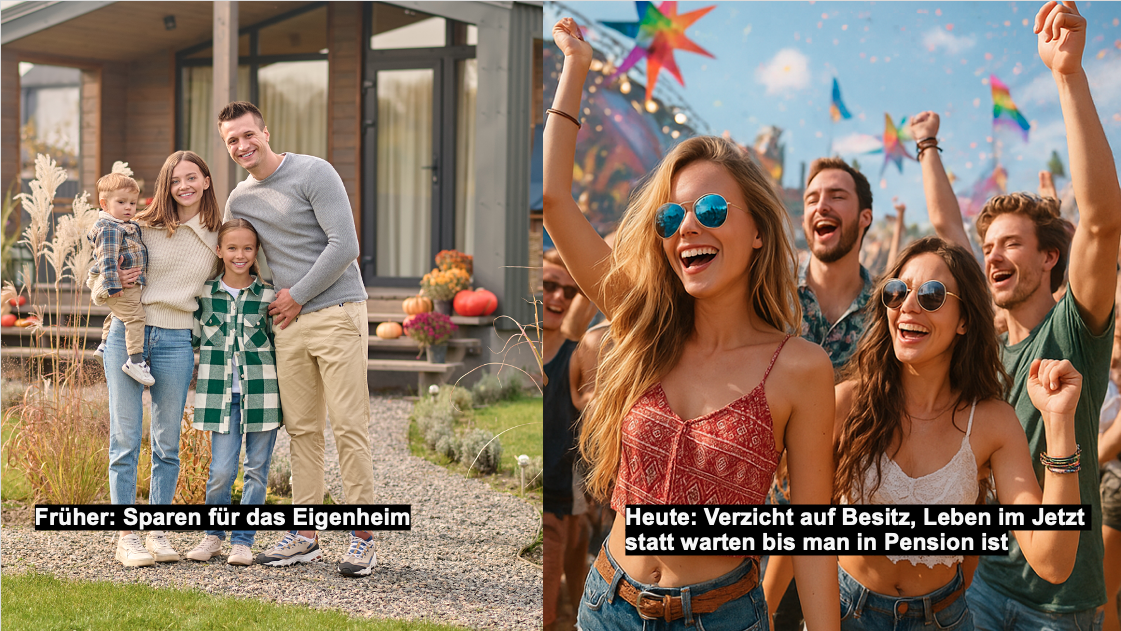
People will no longer save less for later – and invest more in today:
- World travel
- Fine-Dining
- Instagrammable Trips
- Bucket list experiences
Brands must be “immediately noticeable”, not just fulfill brand promises after years.
Trend 6: Loss of trust – authenticity becomes a premium resource
Deepfakes, fake news and AI-generated content have distorted digital perception to such an extent that many people are asking themselves: is what I’m seeing real? In this crisis of trust, the value of immediacy is increasing. Real experiences have a credibility that no algorithm can simulate. They need no explanation, no glossy staging – they work because people have experienced them themselves.
Brands that create authentic moments deliver the most valuable commodity of our time: reliable reality.
The experience gap – why brands fail despite their best efforts
Many brands invest heavily in marketing – but only a few create real experiences. This is where the experience gap opens up: the gap between what brands think they deliver and what people actually feel. This discrepancy has become the most dangerous weak point of modern brand management. Because while companies are convinced that they convey their messages clearly and emotionally, customers often experience something completely different: interchangeability, sensory overload, lack of relevance. Only brands that recognize this gap and consistently close it are able to make a lasting impact – not through words, but through experiences that last.
Why is it like this?
These 5 misconceptions contribute to this:
Misconception 1: “We are a B2B brand, we are not as emotional as Coca-Cola or Nespresso.”
Wrong.
Every brand can – and must – be experienced.
Many B2B brands believe that they cannot compete with brands such as Coca-Cola, Nespresso or Red Bull when it comes to quality of experience. At first glance, they seem less emotional, less visible, less “exciting”. And this is precisely where a dangerous fallacy arises: even if a product is more complex, requires more explanation or is less consumer-oriented, this does not mean that it cannot be made tangible.
The truth is: every brand can – and should – be experienced. Experiential moments create orientation, trust and differentiation, especially in the B2B context. Whether through immersive presentations, tangible use cases, interactive touchpoints or human stories from everyday working life – experiences make even the most technical brand understandable, approachable and relevant.
Misconception 2: “We have to do big roadshows, otherwise it won’t count.”
Wrong.
It’s not about greatness, but about genius.
Many companies believe that only large roadshows or elaborate series of events can have a real impact. As if size is automatically synonymous with relevance. But this idea is misleading. Impact is not created by square meters, budget or number of participants – but by clever, surprising and precisely staged experiences.
The reality is: you don’t need a mega production to move people. A single, small, brilliantly designed touchpoint can have a more lasting effect than an event with a budget in the millions. It’s not the size that matters, but the idea behind it – and how it triggers emotion, clarity and enthusiasm.
Misconception 3: “We show Behind the Scenes on social media – that’s enough.”
Wrong.
In times of deepfakes, nobody believes in surfaces anymore.
Many companies assume that a few “behind the scenes” posts on social media are enough to appear authentic. But in an age where deepfakes, filters and AI content are omnipresent, hardly anyone believes in just the surface anymore. A look behind the scenes loses its evidential character if it is not clear whether what is shown is real at all.
The truth is: experiences must be real, measurable and tangible. Not just claimed to be authentic, but actually experienced. Brands gain trust not through supposed proximity on social media, but through real encounters, clear evidence and tangible quality.
Misconception 4: “We already do so much marketing – now brand experience too?”
Wrong.
Brand experience is not an additional channel.
It is the linking all existing touchpoints into one experience.
Many companies believe that brand experience is just another marketing channel that eats up additional resources. Along the lines of: “We already do so much anyway – what else is there to add?” But this is precisely where the misunderstanding arises. Brand experience is not another tool in the list of measures, but the connecting framework that welds all existing touchpoints together into a consistent experience.
The reality is: consistency beats budget. It’s not about doing more, but about linking what already exists in a way that can be experienced – logically, emotionally and recognizably. A strong brand experience is created where individual measures no longer stand next to each other, but reinforce each other.
Misconception 5: “We are visible at trade fairs – that’s enough.”
Wrong.
You’re at trade fairs and events, but nobody remembers you remember your appearance because you get lost in the crowd.
Many companies rely on the fact that their presence at trade fairs is enough to keep them relevant. But visibility alone does not guarantee perception – and certainly not memory. Brands do not disappear because they are not present, but because their presence leaves nothing behind that sticks.
The truth is: without a clear, well thought-out Unique Experience Proposition (UXP), every trade fair becomes a losing proposition. Only when people feel, understand and experience what a brand stands for will a connection be created that has an impact beyond the trade fair stand. It is not square meters or exhibits that are decisive, but the quality of the experience that remains in people’s minds.
What brands need to understand now: Experiences are multidimensional
But what makes a good brand experience?
People judge after 3 uses:
- cognitive benefit
- social benefit
- emotional benefit
The aim of a successful brand experience is to positively surprise people beyond their expectations and touch them emotionally. Only when an experience delivers more than you expected does real closeness arise. It is precisely this moment that creates the basis for deep, long-term brand loyalty – not through words, but through tangible impact.
And how can it be achieved?
What brands need to understand now: Experiences are always multidimensional. The more senses, emotions and forms of interaction are addressed, the more firmly the experience is anchored in the memory. Each additional dimension increases the chance that people will not only take part, but also remember, talk about and return in the long term. Multidimensionality is therefore not a nice-to-have, but the key to sustainable impact.
From USP to UXP – Why feelings have a stronger impact than facts
The classic unique selling proposition has had its day. Products alone hardly differentiate brands today – they are too interchangeable, too comparable and can be copied too quickly. The decisive factor is no longer what a brand sells, but how it feels. The unique experience proposition focuses precisely on this emotional experience. People don’t love brands because of individual features, but because of the feeling that remains after contact. A strong experience creates differentiation where product features are no longer enough – and makes brands unmistakable.
The experience economy is no longer a trend – it is a reality. It is changing how brands are perceived and making them more human, emotional and relevant. Today, it is not the brands that communicate the loudest that win, but those that really touch people. Those who create experiences are remembered and loved. Those who only send are overlooked.
This is exactly where KESCH comes in: We design experiences that work – for Coca-Cola, Nespresso, Huawei, Hornbach and many more. But above all, we design them for those who really matter: for people.
Here are our 7 key strategies for brands:
- Brand experience as a top priority
- Create unforgettable moments
- Using storytelling for emotional connections
- Use technology for seamless experiences
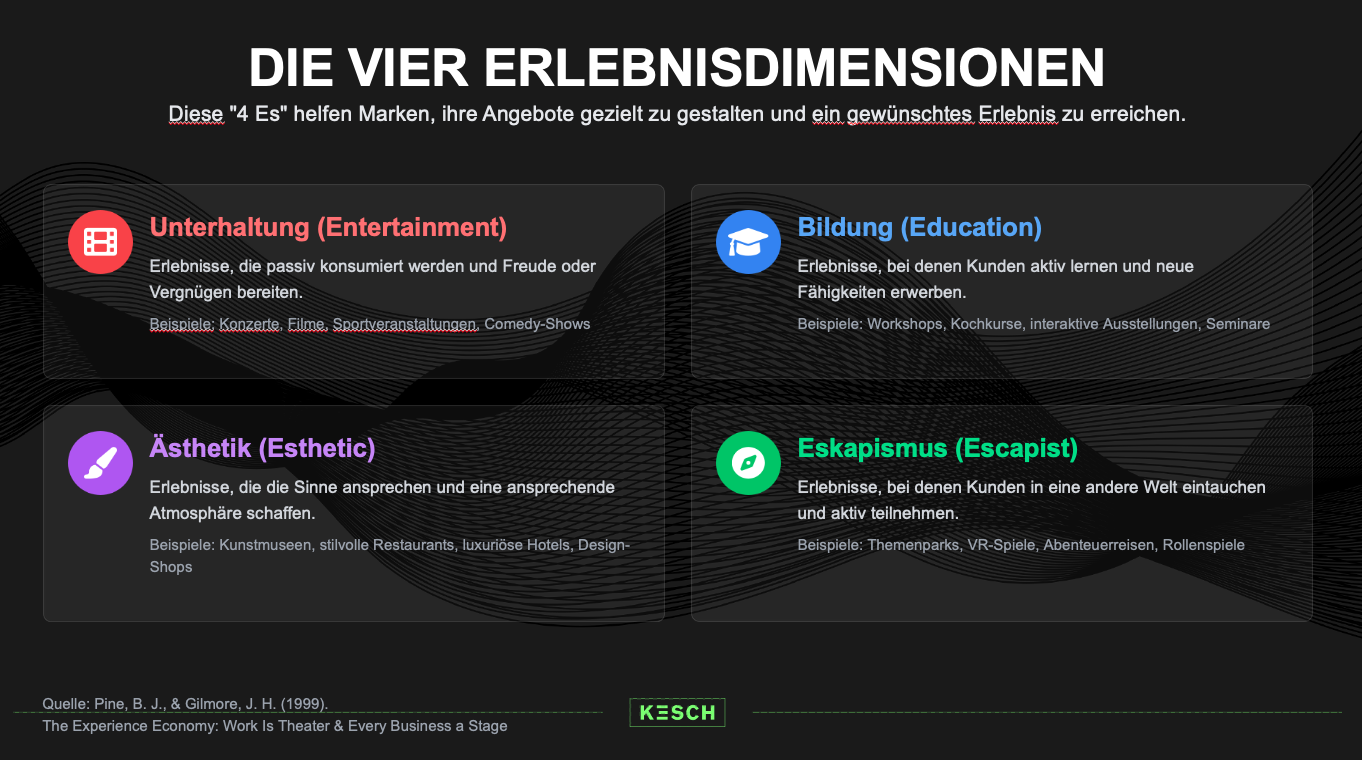
- Think of the 4 Es
- UXP instead of USP
- Add a brand experience agency to your agency portfolio
Would you also like to close your experience gap and create real experiences for your customers? Then let’s talk together!